


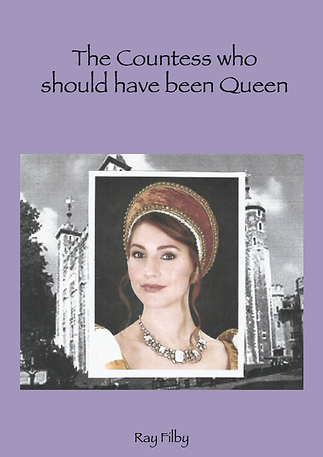
OUTRAGE! How often do you feel so outraged that you need to take some action? When I investigated just who was the person listed as Margaret, Countess of Salisbury, on the board at Tower Green as one of those who had been executed on that site, I was so outraged at the treatment meted out to this saintly woman that I felt that I needed to write this book.
I recommend that before starting the main part of this novel, you, the reader, should first look at the genealogies included at the front of the book. I apologise that the print for these tables is necessarily small to condense the complex information on to a single page. The course of Margaret Pole’s life is directly affected by her relationship with many of the people appearing on these family trees. The names, Henry, Edward and Richard occur so often in the story which unfolds, that reference to the family trees will help you, the reader, recognize which particular Henry, Edward or Richard is being encountered in the story and how he is related to Margaret. In Tudor times, Thomas also crops up quite a bit as a popular Christian name and for the women, Margaret, Elizabeth, Catherine, Mary and Anne are also recurrent names.
While, it may appear that the emergence of the Tudor dynasty brought stability to England after the futile Wars of the Roses, both Henry VII and VIII felt very insecure. This becomes very apparent from the final family tree which precedes this foreword. Members of the Plantagenet family shown highlighted were executed or killed because they were seen as having a better claim to the throne than the Tudor kings. They therefore, represented a threat.
Continental royal families were aware of the insecurity of the Tudor dynasty and Ferdinand of Spain was reluctant to let his daughter, Catherine, marry Arthur, Henry VII’s son, until a prime claimant to the throne, Margaret’s brother, Edward, Earl of Warwick, was removed. Henry had no legitimate reason to execute Edward who was a prisoner in the Tower, but by sending the pretender, Perkin Warbeck, to the Tower where he would meet Edward, Henry knew it was only a matter of time before Perkin would persuade Edward to join with him in plotting against the crown. This indeed happened and Perkin and Edward were executed when they botched an attempt to escape from the Tower. This cleared the way for Arthur to become betrothed to Catherine of Aragon
Henry VII had an interesting way of dealing with those he considered dangerous and this may have had the effect of making him appear to be a merciful monarch. He had potential rebels imprisoned until they signed confessions, perhaps obtained under torture. These confessions would normally have represented a death warrant. However, once Henry had these confessions, which he knew could be used at any time if necessary to secure a death sentence against the person who had made the confession, he released them, subject to their paying a huge fine. The money so raised filled the royal treasury and enabled Henry to maintain a standing army which could be quickly mobilized to put down any threatened rebellion.
Henry VIII dealt with any threat in a much more drastic manner. Whenever he encountered any form of opposition, a mock trial was arranged. The defendant was invariably declared guilty and dispatched to the Tower to await execution.
Can I justify the title of this book, ‘the Countess who should have been Queen’? Margaret appears in the middle of the Yorkist family tree. Her younger brother predeceased her, leaving only the children of Edward IV who could claim precedence over her. However, they had been declared illegitimate. Otherwise it could be argued that Elizabeth of York should have been recognized as Queen Elizabeth I and Henry, Duke of Richmond, as her consort, not as King Henry VII in his own right! After all, Henry VII himself was descended from a branch of the royal family of questionable legitimacy. By the rules of primogeniture, Margaret certainly had a stronger claim to the crown than Henry VII, hence his enthusiasm for her marriage to a commoner!
Let us return to the comment made earlier in this foreword on the importance of family trees to understand the reasons why the plot of a story develops in the way it does. Remember that the most important book in the world, the New Testament, starts with a genealogy. How many skip this as totally boring and move on to the narrative of the life of Jesus? However, this genealogy deserves attention. It shows how Jesus, the son of God, was legally born of a line which didn’t just contain kings, but prostitutes and adulterers! God is not a respecter of a person’s reputation in fulfilling his purposes. Mathew describes the breakdown of the genealogy as three groups of fourteen generations. Could not this equally well be described as six groups of seven generations? This would make Jesus the first son of the seventh generational group of his family tree. Seven is a very symbolic Biblical number. In Irish culture, it is considered very special to be seventh son of a seventh son!
Finally, this is not a history or even a biography but a novel. Conversations, minor characters and insignificant events are purely fictitious. However, having said that, the author has attempted to remain true to major established events of history and has relied heavily on the internet for the historical information included. Where the sources information are in conflict, the author has gone with the line which best suited the development of the story which unfolds. Margaret, Countess of Salisbury has been the subject of other novels and should the reader wish to peruse a more scholarly and detailed account of Margaret’s life than that covered by this brief novelette, they might turn to,
Samantha Wilcoxon’s ‘Faithful Traitor’ or
Philippa Gregory’s ‘The King’s Curse’